
Montgomery County Court Records After Arrest
After a Montgomery County arrest, the jail and the court track different parts of the same event. Montgomery County Correctional Facility tracks custody, booking, visitor access, mail identifiers, release, and facility rules. The court record tracks the criminal case: the docket number, defendant, court, filing date, charges, grade, statute, bail, events, warrants, dispositions, and orders. A person can be booked before every court entry appears online, and court entries can change after the first filing.
The 2025 Montgomery County Pretrial Services report explains that the Assessment Unit is located at MCCF and operates every day. Staff schedule interpreters, coordinate defense counsel interviews, manage arraignment scheduling, attend preliminary arraignments, and attend bail review hearings. Preliminary arraignment is the first court appearance after arrest and is procedural, not a decision about guilt. For custody and booking details, use Montgomery County jail inmate records. For booking photos, use the separate Montgomery County jail mugshots page.
Search Court Records After Jail Arrest
The primary public court search is Pennsylvania UJS Case Search. Use Magisterial District Court dockets for early arrest, preliminary arraignment, and preliminary hearing matters. Use Criminal Courts of Common Pleas dockets for cases that are bound over, filed by information, or handled in the county trial court. The Montgomery County Court of Common Pleas page gives local court context and official court links.
- Open UJS Case Search and choose a criminal docket search path when available.
- Search by defendant or participant name, or use the docket number when it is known from paperwork or a notice.
- Select Montgomery County and the right court type if the portal offers filters.
- Open the docket sheet and read the charge list, bail entries, events, warrants, and dispositions.
- For certified copies, use the Montgomery County Clerk of Courts or the court office listed on the docket.
| Field Label | Type | Required | Notes |
|---|---|---|---|
| Defendant / participant name | Text | One search path | Use exact name variants; middle initial can matter. |
| Docket number | Text | Optional | Most precise route to a known case. |
| Court type | Filter | Optional | Use Magisterial District Courts or Criminal Courts of Common Pleas. |
| County | Filter | Optional | Select Montgomery when available. |
| Date range | Date/filter | Optional | Helpful for common names or known arrest month. |
Charges Filed After Montgomery Arrest
The charge path starts with police allegations and may move through prosecutor review. A criminal complaint can begin the case and allege facts and offenses. Preliminary arraignment addresses identity, counsel, bail or release conditions, and the next court date. If the case moves forward, charges may be amended, reduced, withdrawn, dismissed, held for court, resolved by plea, diverted, or tried. Kevin Steele is identified in the research as Montgomery County District Attorney, and the DA's office is the county prosecutor for criminal cases after arrest.
| Document | Who Uses It | What It Does |
|---|---|---|
| Criminal complaint | Police or prosecutor | Starts the criminal accusation and lists alleged facts and offenses. |
| Information | Prosecutor | Formal charging document used after a case proceeds in Common Pleas court. |
| Indictment | Grand jury process | Charging route for some serious or specially handled cases. |
Montgomery County Charge Status
A charge on a booking record is not always the final court charge. Court records after a jail arrest can show that a charge was held, changed, withdrawn, dismissed, or resolved. The Pretrial Services report's glossary helps define several terms that appear in dockets, including preliminary arraignment, failure to appear, fugitive of justice, indirect criminal contempt, nolle prosequi, and disposition.
| Status | What It Means |
|---|---|
| Pending | The charge remains open and has not reached final disposition. |
| Held for court | The case moved beyond the preliminary stage toward Common Pleas handling. |
| Withdrawn / nolle prosequi | The prosecutor formally withdrew the charge or declined to proceed. |
| Dismissed | The court ended the charge without a conviction. |
| Conviction | The case ended in a guilty plea, verdict, or other conviction result. |
| Diversion | The case followed a program route rather than a standard conviction path. |
Bail Review After Arrest
Montgomery County's 2025 Pretrial Services Annual Report gives strong local bail data. It says Common Pleas conducts bail review hearings where monetary bail has been ordered but not posted and where electronic monitoring has been imposed. With limited exception, hearings occurred on the next business day. Defendants held on unrelated detainers or active sentences are not eligible for bail review, even if the bail on the new case changes.
In 2025, Common Pleas conducted 1,101 bail review hearings. The report says 99 percent involved monetary bail, bail was modified in about 45 percent of cases, and about 78 percent of actual bail modifications reduced monetary bail. A reviewed subset led to 177 additional releases after bail review. Those numbers support the report's conclusion that financial conditions were a primary driver of detention for people eligible for review.
| Release Term | Local Meaning |
|---|---|
| ROR / recognizance | Release without posting money, subject to court conditions. |
| Monetary bail | Financial condition that can keep a person in custody if not posted. |
| Electronic monitoring | Release condition reviewed in a small share of bail review matters. |
| Detainer or active sentence | Separate legal hold that can block release even when bail changes. |
Warrants and Arrest Records
The Montgomery County Sheriff's Office Most Wanted page links active bench warrants and a confidential tip form. A bench warrant is often issued for failure to appear or court noncompliance. The Pretrial Services report also tracks Fugitive of Justice, Indirect Criminal Contempt, and Failure to Appear hearing categories. When a warrant leads to arrest, check UJS for the case entry and MCCF for current custody.
A warrant record is not the same as a conviction. It can show that a judge authorized custody or that a person missed a required event. If a warrant may be active, confirm through UJS, counsel, the sheriff or court contact, or the court listed on paperwork. If the person is arrested on the warrant, the court record should be checked again for preliminary arraignment, bail, and the next court date.
Charges vs Convictions
Court records after a Montgomery County arrest often show charges before any final result. A charge is an accusation in a filed case. A conviction is a final guilty result by plea, verdict, or other court disposition. The distinction matters for job, housing, licensing, immigration, and record-clearing questions, but this site is not a consumer reporting agency and cannot be used for FCRA-covered decisions.
| Charge | Conviction | |
|---|---|---|
| Stage | Accusation after arrest or filing | Final guilty result or plea |
| Can change? | Yes, it may be amended, reduced, withdrawn, or dismissed | Changes only through later court action |
| Where seen? | UJS docket and charging documents | UJS disposition and certified court records |
Sealed and Expunged Records
Some court records after an arrest may be unavailable online or limited by law. Sealed records are hidden from normal public view but may still exist for authorized users. Expunged records are removed or treated as cleared under the applicable court order. Juvenile cases, dependency matters, sealed cases, expunged cases, protected CHRIA information, and active investigative material need special handling.
| Sealed | Expunged | |
|---|---|---|
| Public visibility | Usually blocked from public search | Removed under the order's terms |
| Record still exists? | Often yes for limited official access | Access is much more limited after the court process |
| Where to ask | Court office or counsel | Court office or counsel for eligibility and order status |
Montgomery County Court Search Sources
The statewide UJS Case Search portal is the primary public route for Montgomery County criminal docket sheets.
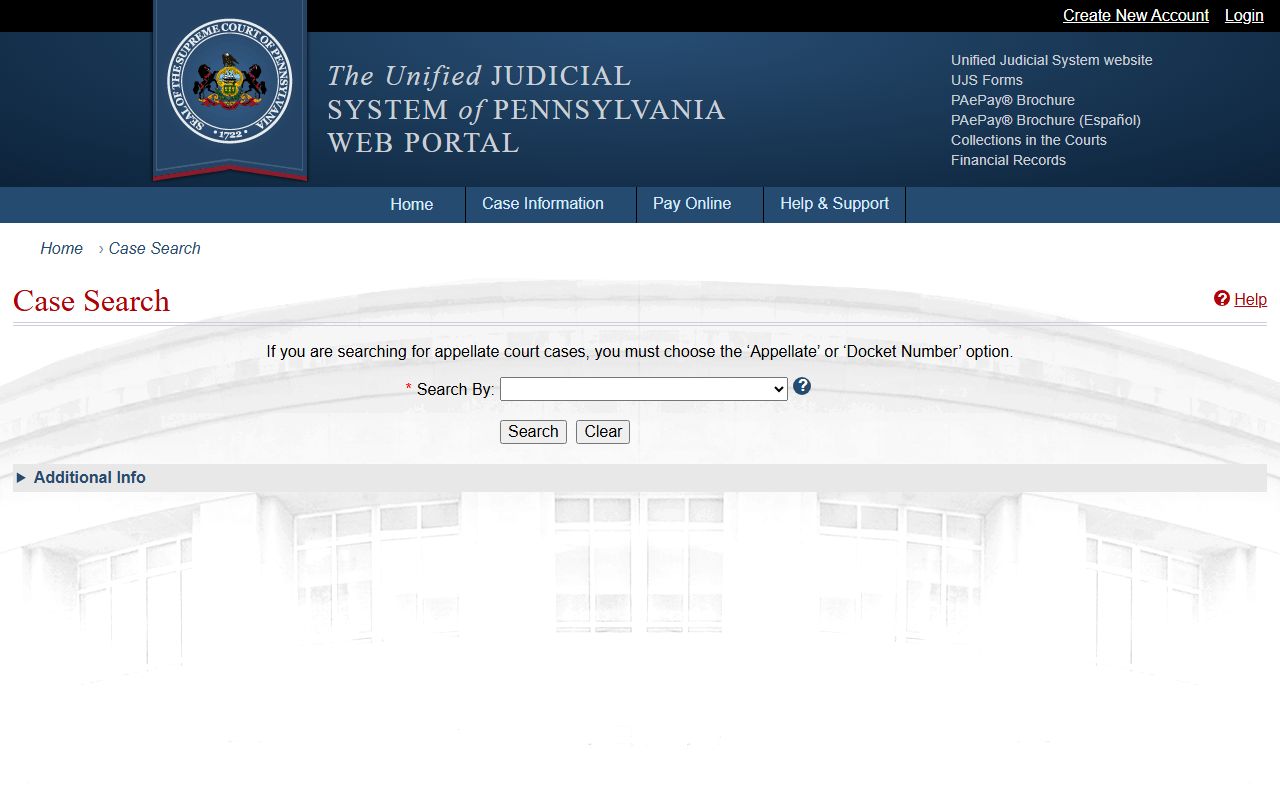
The portal is useful for court records after arrest, but it is not a live MCCF custody roster or mugshot gallery.
The Pennsylvania courts docket sheets page warns that public docket information can be delayed and should not replace an official criminal-history report.
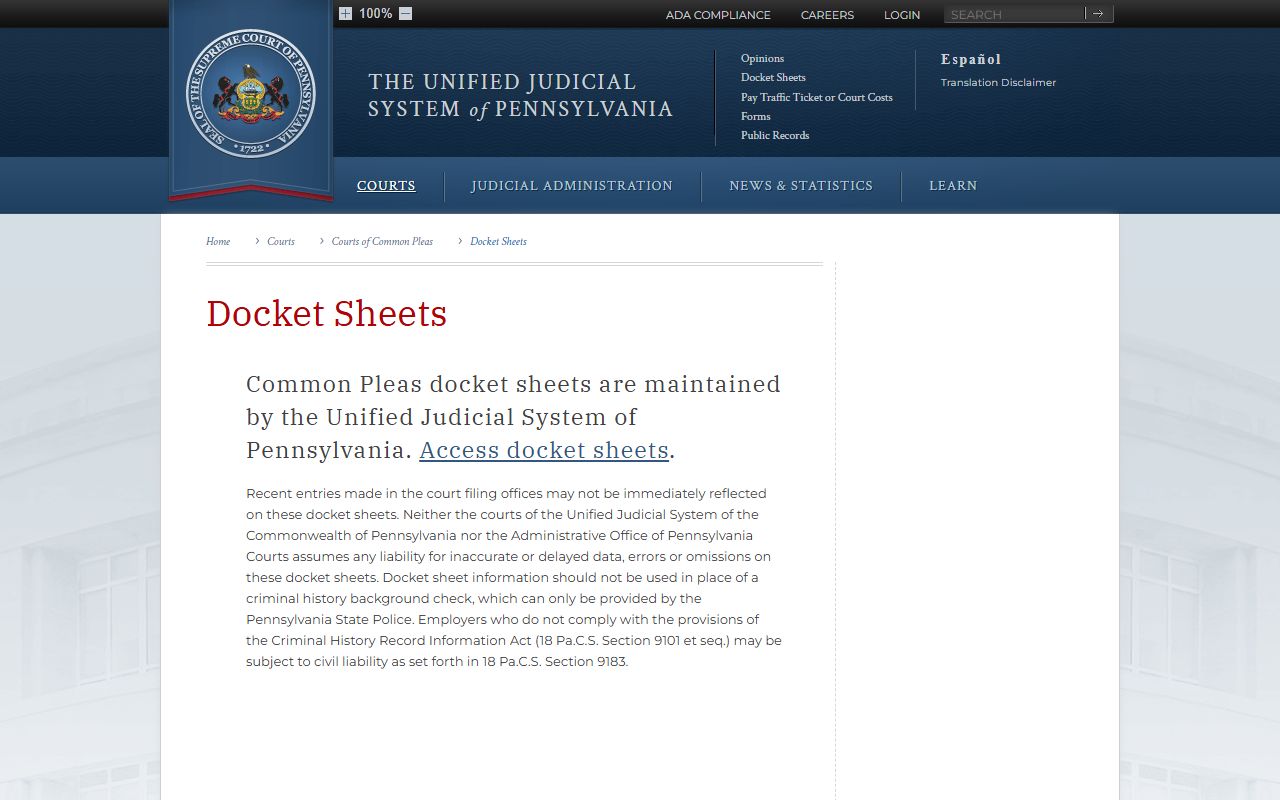
That warning is important when court records are being compared with jail custody, bail, or release information.
Restricted Court Records After Arrest
The Pennsylvania Courts docket sheet page says public docket sheets are informational and may not reflect recent entries immediately. It also says docket sheets are not a substitute for an official criminal history from the Pennsylvania State Police. Pennsylvania's Criminal History Record Information Act governs criminal history record information, and the Right-to-Know Law does not override every criminal justice confidentiality rule.
Important: Verify custody with MCCF, court case status with UJS or the Clerk of Courts, and criminal history through the proper Pennsylvania State Police channel.