
Youth Center Juvenile Custody
The official Montgomery County Youth Center page describes a coed residential facility for juveniles with two separate programs: secure detention and shelter. Secure detention is for youth alleged to have committed delinquent acts and awaiting juvenile court hearings. Shelter serves youth in minor delinquency, dependency, runaway, truant, or ungovernable situations. The facility is included in the Montgomery County detention map, but it is not a source for adult jail inmates.
That difference controls the records approach. Adult terms such as inmate roster, booking mugshot, and public jail list do not fit this facility. Youth Center residents are juveniles, and juvenile records are restricted in ways that adult MCCF records are not. Parents, guardians, attorneys, Juvenile Probation, the juvenile court, and assigned caseworkers are the practical contact channels. Public web searches should not be expected to reveal a resident list.
Youth Center Records Lookup
The Youth Center should not be treated like Montgomery County Correctional Facility or SCI Phoenix. There is no adult-style public inmate search for juvenile residents in the research materials. For secure detention, admission requires Montgomery County Juvenile Probation approval and a signed, notarized delinquency petition or a court order. Those requirements point to official juvenile-court and probation channels, not to a public roster.
Family members trying to confirm placement or a schedule should use the caseworker, juvenile probation contact, attorney, or court notice connected to the youth's matter. A person outside that circle may not be entitled to custody details. When the question concerns an adult arrest, use MCCF instead. When the question concerns a state-sentenced adult, use the PA DOC locator and SCI rules.
- Confirm whether the matter is juvenile detention, shelter, adult county jail, or state prison custody.
- For Youth Center detention, contact the assigned caseworker, attorney, Juvenile Probation, or the court listed on the paperwork.
- Use the Youth Center phone for general facility routing, not for broad public resident-list requests.
- Do not search commercial mugshot or adult jail sites for Youth Center residents.
Note: Juvenile detention records are restricted; adult inmate roster and mugshot rules should not be applied to Youth Center residents.
Youth Center Contact
The Youth Center's public contact information is useful for facility routing, but placement and case details still depend on juvenile-court permissions and caseworker channels. The county identifies Jed Johnson as Executive Director in the research material. Visitors and family members should confirm all appointment details before arriving because the building has screening rules and visit limits.
Montgomery County Youth Center
540-550 Port Indian Road
Norristown, PA 19403
610-631-1893
Executive Director: Jed Johnson
| Question | Appropriate Channel |
|---|---|
| Secure detention placement | Juvenile Probation, court order, attorney, or assigned caseworker. |
| Shelter placement | Caseworker or youth shelter admission channel. |
| Adult county custody | Montgomery County Correctional Facility, not the Youth Center. |
| State prison custody | Pennsylvania DOC locator and SCI facility rules. |
Youth Center Admission
The secure detention page says admission requires approval by Montgomery County Juvenile Probation plus a legally signed and notarized delinquency petition or a court order. The secure program is for youth who need a supervised setting while delinquency issues move through juvenile court. Shelter admission is different and serves minors who need short-term shelter in dependency or lower-level behavior situations.
The court process page gives the timing that often matters most to families. A detention hearing must occur within 72 hours. The research notes hearings on Monday, Wednesday, and Friday. If detention continues, adjudication often must occur within the next 10 days, and disposition within the next 20 days for many residents. Those timelines are juvenile-court events, not adult criminal docket search results.
| Stage | Youth Center Detail |
|---|---|
| Secure detention admission | Juvenile Probation approval and signed/notarized petition or court order. |
| Detention hearing | Within 72 hours. |
| Hearing days | Monday, Wednesday, and Friday in the research material. |
| Continued detention | Adjudication in the next 10 days and disposition in the next 20 days for many residents. |
Youth Center Visitation
The county visitation page limits who can visit based on the resident's program. Secure detention visits are for parents and guardians. Shelter residents may receive parents and immediate family, such as siblings and grandparents. Visits are scheduled through the resident's caseworker, and the research states that two visits per week are allowed, with possible post-court-hearing visits.
Visitor screening is strict. Visitors need photo identification and must pass through a metal detector. The county bars cell phones, purses, tobacco, matches, lighters, and contraband from the building. Family documents may be required in some situations, so a scheduled visit should be checked with the caseworker before travel.
| Rule | Secure Detention or Shelter Detail |
|---|---|
| Secure detention visitors | Parents and guardians only. |
| Shelter visitors | Parents and immediate family. |
| Scheduling | Through the resident's caseworker. |
| Visit limit | Two visits per week, plus possible post-hearing visits. |
| Entry screening | Photo ID and metal detector required. |
| Prohibited items | Cell phones, purses, tobacco, matches, lighters, and contraband. |
The official Youth Center visitation page is a matching visual source for the family-visit rules.
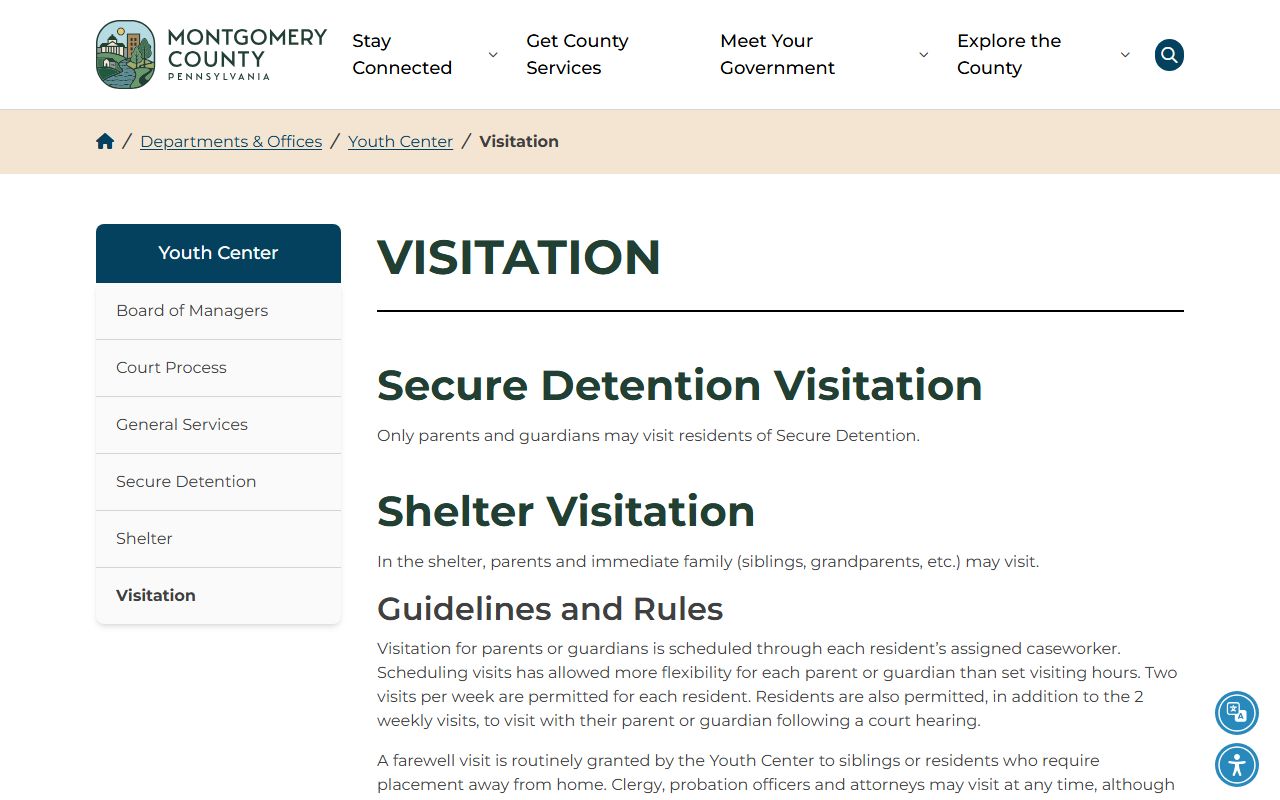
The screenshot reinforces the core point: visits are scheduled family contacts, not public jail-visiting access.
Youth Center Mail Calls
The Youth Center general services material says residents may send and receive mail. Staff do not read incoming or outgoing mail, but mail is distributed through caseworker and administrative handling to reduce contraband in living units. That procedure is facility-specific and should not be confused with MCCF's scanned-mail address or SCI Phoenix's Smart Communications address.
Phone access is also different from adult jail vendor calling. The research says youth may call home twice per week, with a 15-minute limit. Incoming calls are not permitted unless approved by a caseworker or administrator. The billing setup number captured in the research is 1-800-483-8314, but families should still work through the caseworker when permission or contact timing is uncertain.
- Secure detention
- A supervised juvenile setting for youth alleged to have committed delinquent acts and awaiting juvenile court action.
- Shelter
- A non-secure Youth Center program for dependency or lower-level situations such as runaway, truant, or ungovernable behavior.
- Adjudication
- The juvenile court stage that decides whether the allegations are proven.
- Disposition
- The juvenile court's order after adjudication, similar in timing role to sentencing but under juvenile rules.
Youth Center Services
The general services page describes casework, food, education, medical services, mail, telephone access, religious services, and Prison Rape Elimination Act information. School is part of the daily facility routine. The research notes that detention school runs Monday through Friday from 9 a.m. to 3 p.m., matching the shelter education schedule.
The Youth Center's PREA audit details are unusually specific in the research. The first onsite PREA audit was June 9-10, 2014, finalized June 30, 2014, with zero corrective actions. The last audit captured in the research was October 9-10, 2023. PREA context belongs here as facility-operations information, not as a public lookup path for named juveniles.
The Youth Center main page is a matching source for capacity, mission, and public contact details.
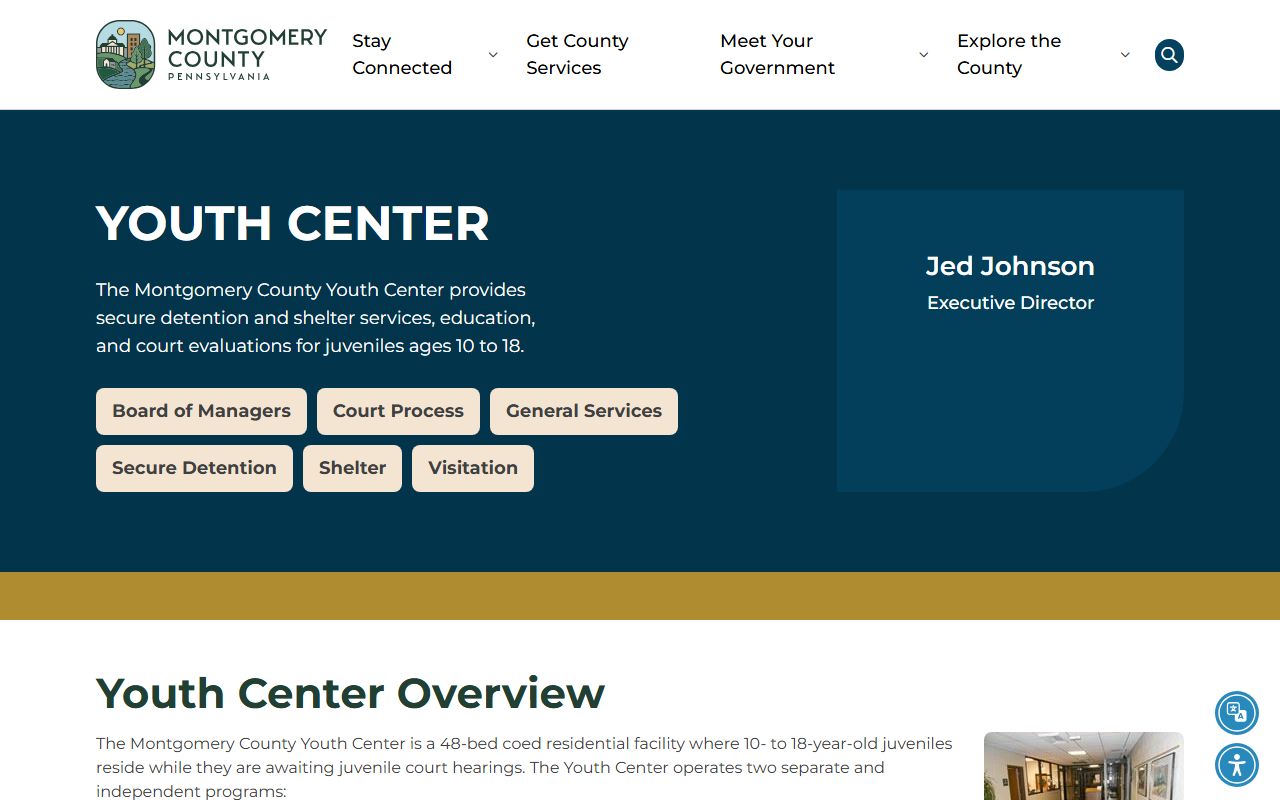
Use that county source for facility facts, then use the caseworker or court channel for resident-specific information.
Youth Center Adult Difference
Montgomery County Youth Center residents should not be included in adult inmate, jail roster, or mugshot content. Adult county custody is handled through Montgomery County Correctional Facility, where the main issue is that no official public online MCCF roster was located. State-sentenced adult men at SCI Phoenix are searched through the Pennsylvania DOC locator. Youth Center matters are narrower, family-centered, and court-controlled.
That distinction protects accuracy. A juvenile detention hearing timeline does not mean an adult bail-review timeline. A shelter visit is not an MCCF visitor-list badge process. A youth call home is not the same as adult jail phone or tablet service. For adult custody pathways, the Montgomery County jail inmate records page covers MCCF, VINE, UJS, and DOC fallback channels.
Note: Confirm all resident-specific details through the youth's caseworker, attorney, court notice, or Juvenile Probation contact.